
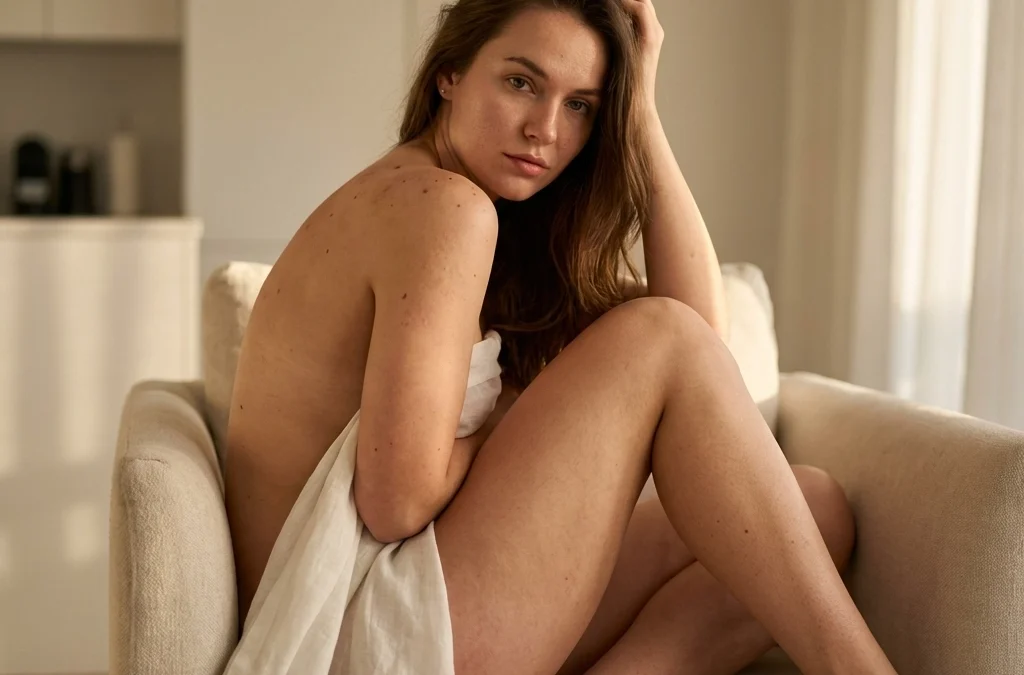
In the world of erotic photography, there is a massive difference between a model who is just standing there naked and a model who is posing. One is a snapshot; the other is art. When you’re working with the female form, your job as a photographer is to translate the three-dimensional heat and energy of a beautiful woman into a two-dimensional frame. To do that effectively, you need to master the geometry of the body: accentuating every curve, every dip of the spine, and the raw emotion held in a gaze.
Whether you’re shooting high-end fine art nude photography or diving into the world of boudoir, the way your model carries her weight and positions her limbs will make or break the shot. Here’s how you take control of the frame to create something truly breathtaking.
The Architecture of the Curve: Creating the S-Shape
The most fundamental rule in art nude photography is the avoidance of straight lines. Straight lines are static; they’re boring. Curves, however, suggest movement, softness, and sensuality. To accentuate a woman’s natural curves, you have to master the "S-shape."
This starts with weight distribution. If a model stands with her weight evenly distributed on both feet, she looks boxy and clinical. Ask her to shift all her weight onto one leg: usually the one furthest from the camera. This naturally causes the hip to "pop" out and the shoulders to tilt in the opposite direction. Suddenly, you have a fluid line running from the neck down to the ankle.
You can also enhance this by having the model twist her torso slightly. A subtle counter-rotation between the hips and the shoulders narrows the waist and emphasizes the swell of the breasts and the curve of the derriere. If you find yourself struggling to visualize these transitions before a shoot, I often recommend playing around with digital inspirations like those found on CandyAI, where you can see how different body types and angles interact with light.
Lighting for Nude Photography: Sculpting with Shadow
You can have the most beautiful model in the world in the perfect pose, but if your lighting is flat, the photo will be too. Lighting for nude photography is about sculpting. You want to use shadows to define the muscles, the ribs, and the valley of the spine.
Side lighting (rim lighting) is your best friend here. By placing your light source to the side or slightly behind the model, you create a highlight along the edge of her silhouette. This "draws" the curve for the viewer’s eye. It’s particularly effective in erotic nude photography where you want to reveal the shape of the body while leaving a bit of mystery in the shadows.
If you’re aiming for something more intimate, try a single softbox positioned high and to the side. This creates a "butterfly" or "Rembrandt" lighting effect on the face while letting the light fall off naturally across her curves. If you’re looking for a deep dive into these setups, you should explore our fine art nude tutorial library, where we break down specific gear and placement for high-end results.
Capturing the Soul: The Face and Expression
In erotic photography, it’s easy to get distracted by the body and forget that the face is the anchor of the image. A beautiful body with a vacant expression feels "plastic." You want a connection.
When posing the face, remember that the jawline is everything. To avoid the dreaded "double chin" or a soft neck, have the model push her chin slightly out and then down. It feels unnatural to her, but through the lens, it creates a sharp, aristocratic jawline.
Eyes are the next priority. If she’s looking directly into the lens, the shot becomes a confrontation: an intimate invitation. If she looks away, it becomes a voyeuristic moment. Experiment with both. A heavy-lidded, "bedroom" gaze can be achieved by having the model close her eyes and then slowly open them on your count of three. This prevents that "deer in the headlights" look and keeps the expression raw and authentic.
Dynamic Poses: From Seated to Lying Down
When you move the model from a standing position to the floor or a bed, the rules of boudoir photography poses change slightly. Gravity becomes your enemy or your ally.
The Seated Arch
Have the model sit on the edge of a bed or a chair. Instead of slouching, ask her to arch her back and push her chest forward while leaning slightly back on her hands. This elongates the torso and keeps the stomach flat. If she’s sitting on the floor, have her pull her knees toward her chest but keep one leg slightly lower than the other. This creates layers of depth and avoids a "clumped" look.
The Lying Triangle
Lying poses are a staple of erotic photography. A classic move is the "Lying Triangle." Have the model lie on her side, facing the camera, and prop her upper body up with one arm. The key here is the arm placement; the supporting elbow should be tucked slightly under the chest to provide lift, while the top leg is bent and pulled forward to hide the "seam" of the groin and accentuate the hip.
Hand Placement: The Silent Storyteller
Nothing ruins a great art nude photography shot faster than "claw hands." When a model is nervous, her hands tend to get stiff. You want her hands to be soft, elegant, and purposeful.
Hands should never be flat against the body. Instead, have her touch herself lightly, using only the fingertips, following the contours of her waist or thigh. Show the side of the hand rather than the palm or the back: this makes the fingers look longer and more graceful. If the hand is near the face, it should barely graze the skin. The goal is to draw the viewer’s eye to a specific area without the hand becoming the focal point.

Mastering the Camera Angle
How you position yourself is just as important as how the model is posed. Shooting from a slightly lower angle can make the model look statuesque and powerful: perfect for fine art nude photography that focuses on the "goddess" aesthetic.
Conversely, shooting from a higher angle can make the model look more delicate and vulnerable, which works beautifully for softer boudoir-style shots. Always try to shoot at a 45-degree angle to the model’s body rather than straight-on. This creates more depth and allows the camera to see the "peaks and valleys" of her form.
Professionalism and Connection
The best nude photography tips aren't just about f-stops and angles; they’re about the environment you create. A model who feels safe and respected will give you better poses. Always communicate what you’re doing. Instead of saying "move your leg," explain why: "If we move this leg forward, it’s going to catch that highlight on your hip perfectly."
Never touch the model to adjust a pose. Use your hands to demonstrate the pose yourself or use verbal cues. When the model feels like a partner in the creative process, her confidence shines through, and that confidence is the sexiest thing you can capture.

Elevate Your Craft
Learning how to photograph nude models is a lifelong journey. It’s about more than just clicking a shutter; it’s about understanding the human form in its most natural, vulnerable state. By mastering the S-curve, controlling your light, and focusing on the subtle details of hands and facial expressions, you move beyond the "nude" and into the "fine art."
If you’re ready to take your skills to the next level and get access to exclusive, high-end behind-the-scenes content and professional galleries, there’s no better place to be. Come see how the pros do it and join a community dedicated to the art of the female form. Check out our membership options today and start your journey toward becoming a master of erotic photography.
Remember, every shoot is an opportunity to find a new angle, a new shadow, and a new way to celebrate the beauty of women. Keep practicing, keep pushing the boundaries of your creativity, and never stop looking for that perfect curve.