
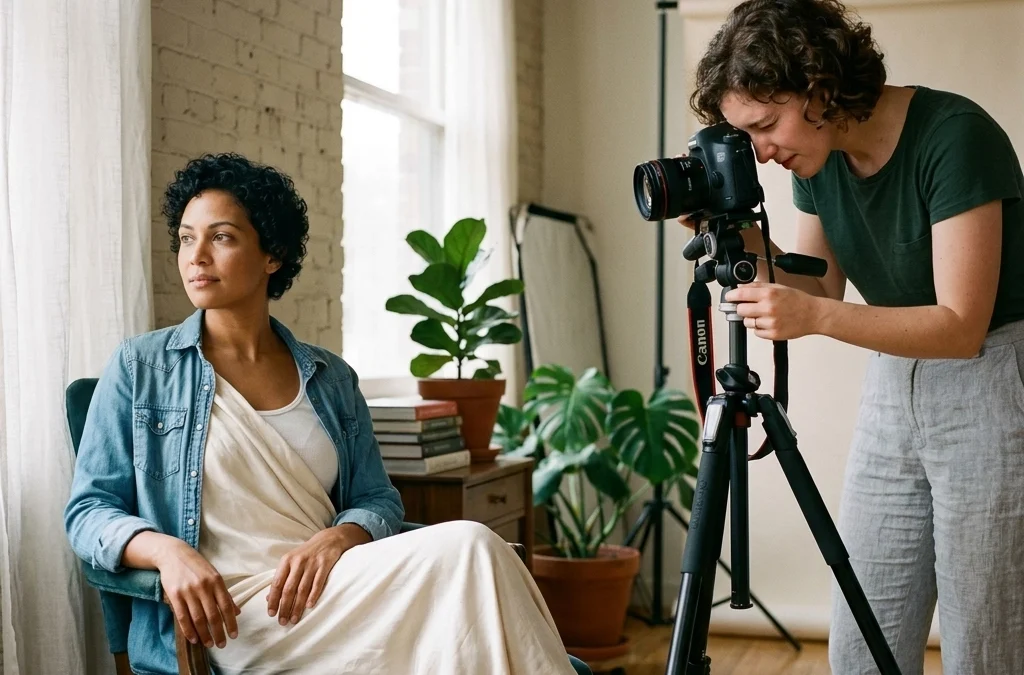
There is something visceral about capturing the raw, unadorned female form. It’s the ultimate challenge for any photographer. When you strip away the fashion, the jewelry, and the props, you’re left with nothing but light, shadow, and skin. It’s intimate, it’s high-stakes, and when done right, it’s breathtakingly erotic. But let’s be real: transition from shooting standard portraits to high-end nude photography isn’t just about asking someone to drop their robe. It requires a shift in mindset, a mastery of your gear, and an absolute obsession with the way light rolls over a curve.
If you’ve been looking to elevate your portfolio and move into the world of fine art and erotic photography, you’ve come to the right place. We’re going to dive deep into the mechanics of the craft, from the initial vibe on set to the technical settings that make skin look like silk.
Setting the Vibe: Trust is Your Most Important Tool
Before you even pick up your camera, you need to understand that a nude shoot is built entirely on trust. You aren't just a guy with a lens; you're a director creating a safe space for a woman to be her most vulnerable. The energy you bring into the room will show up in the final frames. If you’re nervous, she’ll be tense. If you’re unprofessional, she’ll shut down.
Start with a conversation. Talk about the mood. Is this dark and moody? Is it bright and ethereal? Sharing a mood board is essential. Sometimes, I even use tools like CandyAI to visualize different character archetypes or lighting scenarios before the model even arrives. It helps to have a visual reference for the "vibe" you’re chasing.
Keep the set warm, physically warm. A cold model is a shivering model, and goosebumps are rarely the "texture" we’re going for in fine art. Play some music that fits the aesthetic. Most importantly, communicate. Never, under any circumstances, touch the model to adjust a pose. Use your words or demonstrate the movement yourself. If you want her to arch her back or tilt her chin, show her.

Lighting: The Language of the Body
In nude photography, light is your paintbrush. You aren't just illuminating a subject; you are defining her shape. If you light a model from the front with a big, flat softbox, you lose the drama. You flatten the very curves that make the female form so captivating.
To create truly erotic nude photography, you need to master shadow. Chiaroscuro: the contrast between light and dark: is your best friend. Position your light source to the side or slightly behind the model (rim lighting). This creates a "whisper" of light that catches the edge of a hip, the line of a spine, or the swell of a breast while leaving the rest to the viewer's imagination.
Don’t be afraid of hard light, either. While softboxes are great for a commercial look, a bare bulb or a tight grid can create sharp, aggressive shadows that feel modern and raw. Experiment with how shadows fall across the ribs or the collarbone. This is where the magic happens. For a deeper dive into specific setups, our fine art nude tutorial section covers everything from single-light minimalism to complex multi-light arrangements.
Posing the Female Form: Curves and Triangles
Posing for nude photography is an athletic feat for the model. What looks effortless and relaxed in a photo is often the result of a series of very specific, sometimes uncomfortable, adjustments.
The goal is to create "flow" and "negative space." You want to avoid "merging" body parts. For example, if a model is standing straight with her arms flat against her sides, she looks wider and the silhouette is lost. Have her move her elbows away from her body to create "triangles" of light and space. This emphasizes the waist and creates a more dynamic, sculptural feel.
Focus on the "S" curve. Have her put her weight on one leg, pop the opposite hip, and arch the lower back. This lengthens the torso and highlights the natural geometry of the body. Whether you’re shooting a lithe, athletic frame or a woman with lush, heavy curves, the principles remain the same: find the angles that celebrate her unique silhouette.

Technical Mastery: Camera Settings for Skin
When it comes to your gear, you want to get as much detail as possible. Fine art nude photography is all about texture: the fine hairs on the skin, the moisture, the pores.
- Aperture: I love shooting wide open (f/1.4 to f/2.8) for those intimate, soft-focus shots where only the eyes or a specific curve is in focus. However, if you're doing more sculptural work where the whole body needs to be sharp, stop down to f/8 or f/11.
- ISO: Keep it as low as possible (ISO 100 or 200) to avoid digital noise. You want the skin to look creamy, not grainy: unless you’re intentionally going for a raw, film-style look.
- Shutter Speed: If you’re shooting handheld, keep your shutter speed high enough to avoid blur. Since you’re often working in low-light "moody" environments, a tripod is a lifesaver. It allows you to slow things down and really compose the shot without worrying about camera shake.
Manual mode is non-negotiable. Your camera's auto-metering will often get confused by the high contrast of a nude shoot, especially if you have a lot of dark shadows. You need to be in control of exactly how much detail is being pulled out of the highlights.

Composition and Storytelling
What makes a photo "fine art" rather than just a snapshot? Storytelling. Every shot should feel like a moment caught in time.
Try unconventional angles. Don't just shoot from eye level. Get down low to make the model look statuesque and powerful. Shoot from above to create a sense of vulnerability or intimacy. Use foreground elements: a sheer curtain, a piece of furniture, or even just out-of-focus foliage: to "frame" the model and give the image depth.
Remember, you don't always need to show the face. Some of the most powerful erotic nude photography is anonymous. A close-up of the small of the back, the curve of a neck, or the way a hand rests on a thigh can be more provocative than a full-frontal shot. It invites the viewer to fill in the blanks.
The Importance of Diversity
Beauty isn't a monolith. As a photographer, your portfolio should reflect the incredible variety of the female form. Seek out models of different races, skin tones, and body types. The way light interacts with deep, melanated skin is completely different from how it hits pale, porcelain tones. Each presents its own set of challenges and rewards.
Capturing the glow of dark skin against a highlight or the subtle veins beneath fair skin adds a layer of realism and humanity to your work. Diversity isn't just a buzzword; it’s a way to ensure your art stays fresh, relevant, and infinitely more interesting.

Elevating Your Craft
Photographing nude models is a journey of constant learning. You’ll have shoots where everything clicks, and you’ll have shoots where you struggle to find the light. The key is to keep pushing the boundaries of what you think is possible.
Study the masters. Look at how the greats used shadow to hide and reveal. And most importantly, get around other people who are doing the work. If you're serious about taking your skills to a professional level and seeing how the pros handle every aspect of a high-end erotic shoot, you should definitely join the club. You'll get access to behind-the-scenes content, technical breakdowns, and a community that lives and breathes this art form.
Nude photography is a celebration of life, form, and desire. Approach it with respect, master your technical skills, and never stop looking for that perfect whisper of light across the skin. Your best shot is always the one you’re about to take.