
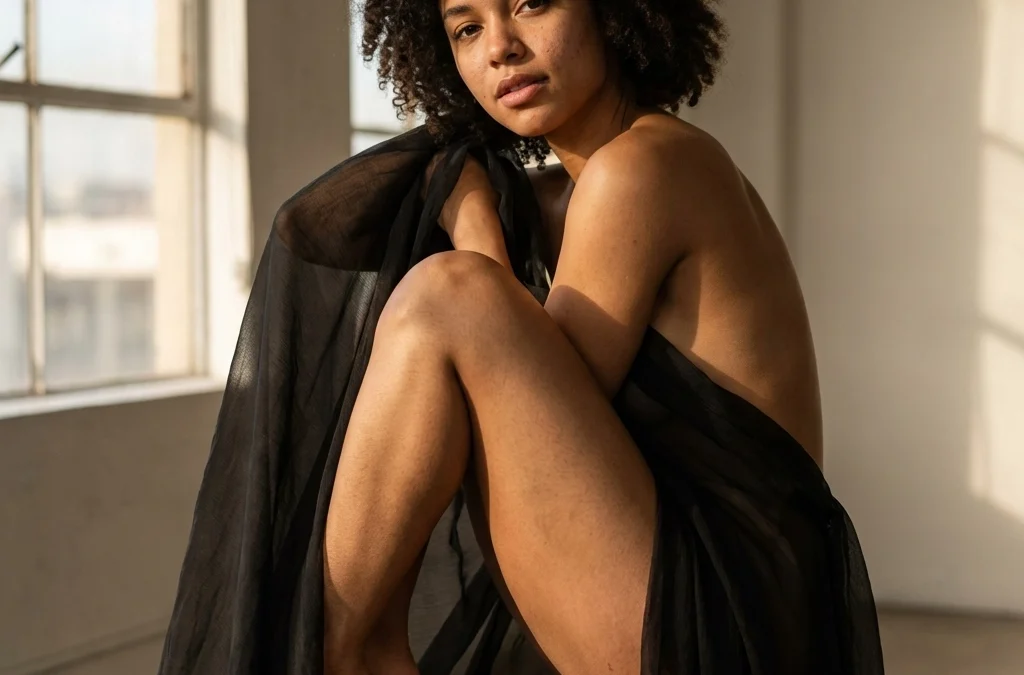
Fine art nude photography sits right on the edge where beauty turns feral, where skin becomes shape, shadow becomes story, and a simple pose can feel like a confession. If you’re here for “safe” images, you’ll get bored fast. If you’re here to make art nude photography that feels expensive, erotic, and impossible to look away from, this guide is for you.
Below you’ll get a full blueprint: how to photograph nude models with real confidence, lighting for nude photography that sculpts instead of flattens, posing nude models without awkwardness, and a workflow that keeps your images clean, luxurious, and undeniably hot.
Category: Fine art nude
1) Start with intent: erotic doesn’t mean chaotic
Erotic photography isn’t “shoot everything and hope something hits.” The best erotic nude photography is controlled: one idea, one mood, one reason the model is nude beyond “because nude.”
Before you shoot, decide:
- What’s the fantasy? Soft morning seduction? Sharp, high-contrast power? Voyeuristic hallway tension?
- What’s the visual language? Curves-as-landscape, cinematic shadows, glossy skin, or stark minimalism.
- What must be true in every frame? (Example: “She looks unbothered and in control,” or “She’s lit like marble.”)
This “north star” makes every decision easier, lens choice, location, poses, even whether the model’s gaze meets the camera or denies it.

2) Model choice + consent: the secret to real confidence on set
If you’re early in nude photography, work with an experienced female nude model at least for your first few sessions. She’ll understand angles, tension, and how to hold a pose without looking stiff. That experience protects the vibe, and the vibe is everything.
Build safety without killing the sexiness
A professional nude set can still feel raw, intimate, and charged, but only if your structure is solid.
Use this baseline every time:
- Clear boundaries in writing: what’s allowed, what’s not, where the images will be used.
- A warm room: nude means cold is the enemy. A space heater is a better investment than a new lens.
- A “pause” option: the model can stop at any time, no explanation required.
- Minimal crew: fewer eyes, more trust, more intensity.
Talk like a human, not a director-bot
Small talk before the first shot matters. Keep it light. Ask what music helps her feel confident. Let her know exactly what you’re going for: “This set is glossy shadows and slow movements, sexy but clean.” Professional, casual, direct.
And when you direct:
- Say what you love immediately (“That shoulder line is perfect.”)
- Give one instruction at a time
- Demonstrate poses yourself if needed (yes, even if it feels dumb: do it anyway)
If you want ongoing guidance that’s built for this genre: posing, lighting, full shoot breakdowns: binge the tutorials at https://fineartnude.club/tag/fine-art-nude-tutorial and steal the workflows that actually work.
3) Gear that matters (and what doesn’t)
You don’t need a “nude photography camera.” You need control over light and a lens that flatters bodies.
Lenses that make nude photography look high-end
- 50mm or 85mm prime: creamy depth, flattering compression, intimate feel without distortion.
- 35mm prime: more environment, more story, but watch edge distortion on limbs.
- Macro (optional): skin texture, lips, fingertips, wet hair: details that feel taboo in the best way.
Camera settings that keep skin gorgeous
- Aperture: f/1.8–f/2.8 for dreamy softness; f/4–f/8 for sculpted clarity.
- Shutter speed: don’t let slow shutter turn sensual into blurry unless motion blur is a creative choice.
- ISO: raise it if you must: grain is better than missed moments.
The real upgrade isn’t a body. It’s learning to see light like a sculptor.
4) Lighting for nude photography: sculpt, don’t flatten
Light is what turns a naked body into a photograph worth money.
Soft light: luxury, skin, and smooth seduction
Soft light wraps around curves and hides distractions. Great for:
- boudoir photography poses
- intimate bed sets
- “morning-after” erotic photography
- close portraits where you want eyes + lips + skin to feel touchable
How to get it:
- Window light + sheer curtain
- Large softbox close to the model
- Bounce light off a white wall
Hard light: drama, power, and expensive edge
Hard light creates sharp shadows that carve the body like stone. It’s bold and graphic: perfect for:
- high-contrast black-and-white
- confident, dominant energy
- minimal sets where the shadow becomes the set
How to get it:
- Bare bulb or small reflector
- Direct sunlight through blinds
- One light source with minimal fill
A simple nude lighting setup that rarely fails
- Key light: 45° to her side, slightly above eye level
- Fill: a white reflector opposite (or none if you want bite)
- Background: keep it darker than skin so she pops
When you’re unsure, go simpler. One light. One mood. Nail it.

5) Posing nude models: make it sensual, not “posed”
The camera loves tension. The body loves comfort. Your job is to balance both.
The golden rule: pose the intention, not the limbs
Instead of “put your hand here,” try:
- “Give me a slow exhale like you’re letting someone watch.”
- “Turn away like you’re denying the viewer: then glance back.”
- “Hold your own body like you’re deciding whether to be sweet or dangerous.”
The limbs will follow when the emotion is real.
Core posing principles for art nude photography
- Create triangles: bent arms, bent knees: angles add design.
- Lengthen the lines: neck long, shoulders down, fingers relaxed.
- Twist the torso: slight rotation defines waist and ribs.
- Hide what you don’t want to feature: forearm across the belly, hair across the chest, knee up for shape.
Boudoir photography poses that translate beautifully to nude
Even if the set is explicit, boudoir structure gives it elegance:
- Side-lying S-curve: hips stacked, top leg bent forward, chin slightly down.
- Kneeling with a hinge: hips back, chest forward, hands on thighs: pure tension.
- Seated edge pose: sit on the edge of bed/chair, shoulders forward, gaze up: sweet and filthy at once.
- Back arch on elbows: body becomes a landscape, shadows do the talking.
A quick “anti-awkward” posing flow
- Start clothed/covered (robe or sheet) for warm-up frames
- Move to implied nude (strategic cover)
- Then full nude once the rhythm is real
- Finish with the boldest setups while confidence is highest
It’s not about being shy. It’s about building momentum.
6) Composition: treat her body like a location
If you shoot nude photography from one spot, you’ll get one image: just repeated.
Do this instead:
- Circle the model: shoot front, 45°, profile, behind.
- Change height: stand on a chair, kneel low, shoot through door frames.
- Crop with intent: collarbone + lips, stomach + hand, hip + shadow: details can feel more erotic than full-body.
A great trick: think of her body as a landscape. Ridges, valleys, highlights, dark pockets. The more you explore with your camera, the more “art” the “nude” becomes.
7) Location + set styling: keep it minimal, keep it seductive
The set should support the body: not compete with it.
Locations that work (and why)
- Bedroom with one window: classic for a reason: soft light, natural intimacy.
- Simple studio + paper backdrop: makes it graphic, clean, and timeless.
- Bathroom: reflections, tiles, steam, mirrors: instant erotic tension.
Styling that adds movement without feeling costume-y
- Sheer fabric (silk, organza)
- A single oversized shirt
- Jewelry (one chain, one ring, one statement piece)
- Heels (if the concept supports it: don’t force it)
A little styling goes a long way. Too much and the image feels like dress-up instead of desire.
8) Directing expressions: the face sells the fantasy
Skin gets attention. Eyes keep attention.
Give prompts that create micro-emotions:
- “Look at the camera like you know a secret.”
- “Close your eyes like you’re remembering something dirty.”
- “Let your mouth part slightly: like you’re about to speak, but choose not to.”
If the model doesn’t know what to do with her face, the whole frame collapses. Keep guiding, keep it simple, and shoot through the transitions: those in-between moments are where the heat lives.
9) Post-processing: keep skin real, make mood intentional
High-end erotic photography isn’t plastic. It’s polished.
Skin editing rules that preserve sensuality
- Remove temporary distractions (blemishes, bruises if requested)
- Keep texture: texture is erotic
- Dodge & burn for shape, not fake “beauty”
- Don’t over-whiten highlights on skin (it kills the warmth)
When black and white makes nudity stronger
Black and white can strip away “pretty color” and force the viewer to feel form, contrast, and shadow. If the scene risks looking too explicit without meaning, monochrome often turns it into pure design: still sexy, but elevated.
10) Practice smarter: build a repeatable nude photography workflow
Your goal isn’t one lucky shoot. Your goal is consistency.
A clean workflow:
- Concept + mood board (10–15 reference frames max)
- Shot list (start safe → go bold)
- Lighting plan (one main setup, one variation)
- Directing cues (emotion prompts, not limb instructions)
- Select fast (choose the frames with the strongest tension)
- Edit for mood (color grade consistent, skin real)
- Deliver professionally (timelines, usage terms, privacy respected)
If you want a steady stream of real-world breakdowns: poses, light diagrams, and how working photographers actually run these shoots: get inside https://fineartnude.club/membership/ and use the community energy to level up fast.
And for concepting when you’re stuck, tools can help: I’ve seen photographers use https://candyai.gg/home2?via=ptn1me to spark mood ideas, dialogue prompts, or character-driven scenarios: then translate that vibe into a real shoot with a real model.
11) Common mistakes that ruin erotic nude photography (and how to fix them)
-
Mistake: shooting too wide, too soon
Fix: start tighter: details, curves, partials: build trust and intensity. -
Mistake: flat light on skin
Fix: move the light to the side. Shadows are your friend. -
Mistake: over-posing
Fix: give actions: “slowly slide the sheet,” “turn like you’re leaving,” “hold your own waist.” -
Mistake: cluttered backgrounds
Fix: remove distractions or shoot with shallow depth of field. -
Mistake: editing skin into wax
Fix: keep texture, dodge & burn for shape, and stop smoothing everything.
12) A quick checklist before you shoot
- Room warm, music on, water available
- Boundaries confirmed, release agreed, privacy respected
- Lighting tested with a stand-in (or yourself)
- One simple starting pose planned
- Directing phrases ready
- You know the emotional tone you’re chasing
That’s the difference between “we took nudes” and “we made art nude photography that feels like a luxury addiction.”