
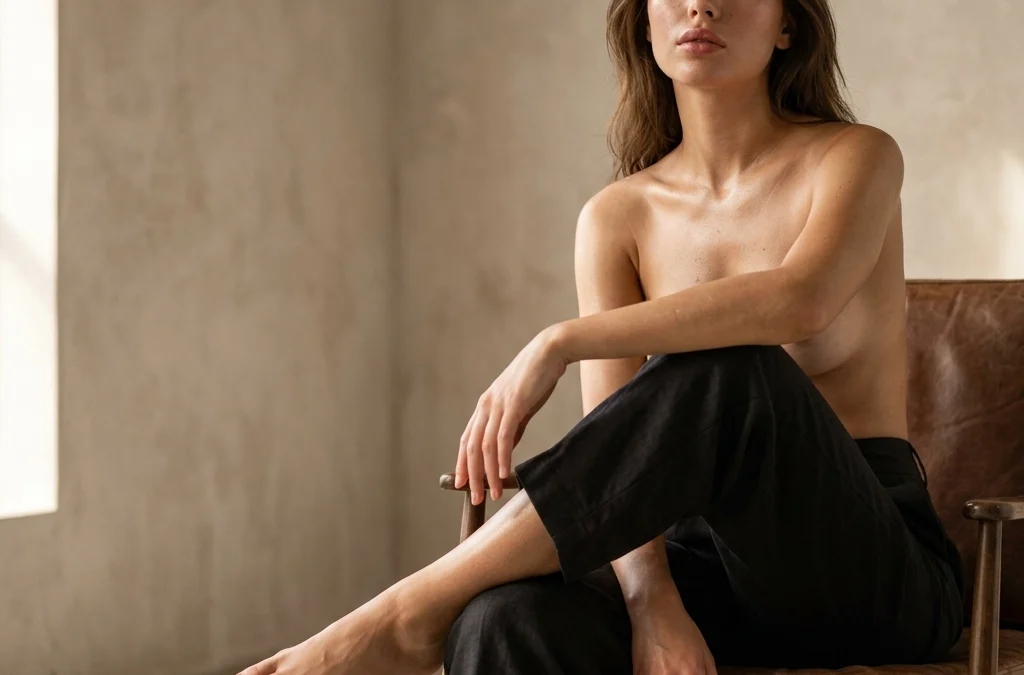
There is a profound difference between taking a picture of a naked body and creating erotic nude photography. One is a clinical record; the other is a visceral experience. To succeed in this niche, you have to master the delicate balance between technical precision and raw, unadulterated emotion. You aren’t just capturing skin; you are capturing a mood, a secret, and the undeniable allure of the human form.
Whether you are just starting out or looking to refine your eye for high-end eroticism, this guide will walk you through the essential elements: from the psychology of the shoot to the final edit.
Establishing the Connection: Comfort and Consent
Before you even pick up your camera, you need to understand that the energy between you and your model is the most important factor in the room. Erotic nude photography requires a level of vulnerability that most people never show. If your subject feels awkward, it will show in every muscle of her body and every look in her eyes.
Start with a conversation. Talk about the vision, the boundaries, and the mood. A professional environment is a safe environment. Keep the studio warm: chills lead to goosebumps and tension: and always have a silk robe or comfortable wrap nearby for breaks. Never touch your model to adjust a pose; instead, use your words or mirror the movement yourself. When she feels respected and in control, she can truly let go, allowing you to capture that genuine spark of eroticism.

Mastering the Language of Light
In fine art nude photography, light is your paintbrush, and shadows are your best friend. Flat, even lighting is for catalogs; eroticism lives in the shadows. To create depth and mystery, you need to master "Chiaroscuro": the dramatic contrast between light and dark.
Soft Light vs. Hard Light
Soft, diffused light is incredibly flattering. It smooths out skin textures and creates a dreamy, sensual atmosphere. Using a large softbox or shooting near a window with sheer curtains can give you that classic fine art nude photography look that feels soft to the touch.
On the other hand, hard lighting adds a raw, edgy energy to the frame. A single, focused light source creates sharp shadows that define the musculature, the curve of the spine, and the arch of a hip. This is where you find the "art" in art nude photography: by showing just enough to tease the imagination while leaving the rest to the darkness.
If you are looking for fresh ideas or want to experiment with different lighting scenarios before you get into the studio, checking out CandyAI can be a fantastic way to visualize complex lighting setups and character moods. It’s a powerful tool for generating inspiration that helps you see how light hits different forms and skin tones.
Posing: Creating the "S" Curve
Posing nude models is an art of geometry. You are looking for lines, triangles, and curves. A body standing straight and flat against a wall is rarely interesting. To create a compelling erotic image, you want to introduce movement and tension.
The "S" curve is the holy grail of boudoir photography poses. By having the model shift her weight to one leg and rotate her torso slightly, you create a natural, flowing line that emphasizes the waist and hips. Encourage her to keep her limbs away from her body: creating "windows" of space between an arm and the torso: to prevent the body from looking like a singular, solid mass.
Every pose should tell a story. Is she confident and reclaiming her power? Or is she soft, vulnerable, and inviting? For those who want to master these nuances, our fine art nude tutorials dive deep into specific posing workflows that work for every body type.
Technical Gear: Choosing Your Lens
Your choice of glass significantly impacts the intimacy of the shot. While wide-angle lenses can create interesting distortions, they are often too clinical for erotic nude photography.
- The 35mm: Great for environmental nudes where the location (like a luxury suite or a sun-drenched beach) is as much a character as the model.
- The 50mm: The "nifty fifty" is versatile and mimics the human eye’s perspective. It’s perfect for mid-range shots.
- The 85mm: This is the gold standard. It provides a beautiful compression that makes the subject pop against the background. It also allows you to stay at a respectful distance while still capturing intimate details, like the curve of a lip or the texture of skin.
Set your aperture wide: think f/1.4 to f/2.8. A shallow depth of field draws the viewer’s eye exactly where you want it, blurring out distractions and focusing entirely on the eroticism of the form.
Composition and Artistic Vision
A great photographer doesn't just "take" a picture; they "make" it. Use the rule of thirds to place the focus on the eyes or a specific curve, but don't be afraid to break the rules for a more avant-garde feel. Leading lines: the line of a leg, the edge of a bed, or a shaft of light: should always point toward the subject.
Experiment with cropping. You don’t always need the whole body in the frame to make a statement. A close-up of a hand resting on a thigh or the nape of a neck can be more erotic than a full-body shot. It’s about the suggestion of intimacy.

Post-Processing: The Final Polish
The goal of post-processing in erotic photography isn't to erase reality; it’s to enhance the mood. You want to keep the skin looking like skin: pores, freckles, and all. Over-smoothing leads to a plastic, "uncanny valley" look that kills the erotic tension.
Focus on color grading. Warm tones (reds, oranges, golds) evoke heat and passion, while cooler tones (blues, cyans) can feel more cinematic and detached. Adjust your shadows to be deep and rich, and use dodging and burning to manually highlight the curves of the body, much like a painter would.
If you're ever feeling a creative block during the editing process, I often find that playing with different aesthetics on CandyAI helps me decide which direction to take a shoot: whether to go for a high-contrast noir look or something more vibrant and modern.
Join the Inner Circle
Erotic nude photography is a journey of constant learning. It’s about more than just the gear; it’s about the vision, the respect for the form, and the community you build along the way. If you’re ready to take your work to a professional level and gain access to exclusive content, behind-the-scenes shoots, and a community of like-minded artists, you should join the Fine Art Nude Club today.

Final Thoughts
Success in this field comes down to persistence and taste. Study the masters of the past, but keep your eyes on the future. The human form is the oldest subject in art, yet it offers infinite possibilities for those brave enough to explore it with a camera.
Keep shooting, keep experimenting with light, and always prioritize the connection with your subject. That is how you move from being a photographer to being an artist. For more technical breakdowns and inspirational galleries, don't forget to explore our full library of tutorials and elevate your craft to the next level.