
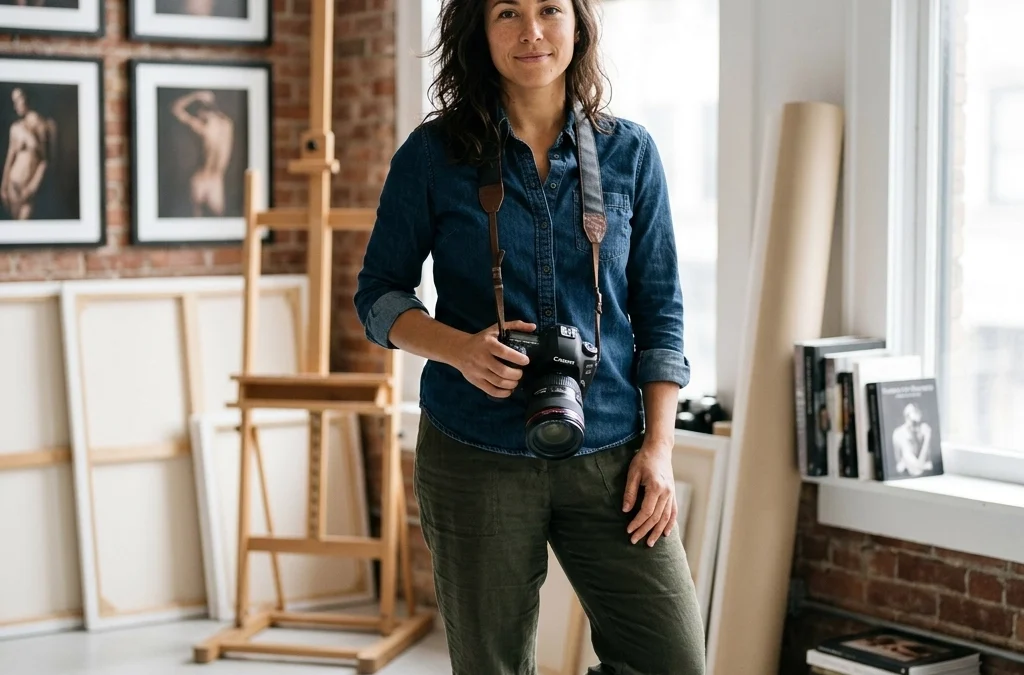
Let’s be honest: most people think fine art nude photography is just about having a high-end camera and a stunning woman willing to take her clothes off. They think you walk into a studio, click a button, and: boom: you’ve got a masterpiece. But if it were that easy, everyone would be doing it, and the world wouldn't be flooded with mediocre, flat images that lack soul.
The truth is, there’s a massive gap between "taking a picture of a naked woman" and creating high-end erotic photography that feels alive. Professional photographers have a secret language of light, psychology, and technical precision that they rarely share in public forums. Today, we’re peeling back the curtain. We’re talking about the raw, visceral techniques that transform a simple session into an artistic explosion.
The Art of Pre-Visualization: Creating the Desire
One of the biggest secrets in the industry is that the shoot begins long before the model arrives. Professionals don't just "wing it." They obsess over the mood. They visualize every curve, every shadow, and the exact tension they want to capture in the frame. Whether it’s the soft, amber glow on a Latina model’s skin or the sharp, high-contrast highlights on a dark-skinned African goddess, the vision must be clear.
Before a model even steps through the door, I often use tools like CandyAI to visualize the aesthetic vibe I'm aiming for, helping me bridge the gap between imagination and the raw reality of the shoot. By generating conceptual looks or exploring different lighting scenarios virtually, you can walk into the studio with a blueprint of desire already mapped out.
The Lighting Secret: It’s Not About What You See, It’s About What You Hide
In erotic photography, light is your paintbrush, but the shadows are your soul. Most beginners make the mistake of over-lighting. They want to see everything. They blast the model with light, flattening her features and stripping away the mystery.
Professional lighting for nude photography is about subtraction. You want to use light to sculpt the body. Think of the human form as a landscape of peaks and valleys. Side lighting is your best friend here. By placing a single softbox or a strip light to the side of the model, you highlight the curve of the hip, the arch of the back, and the subtle texture of the skin while letting the rest fall into deep, suggestive shadows.
When you're working with diverse skin tones, your lighting needs to adapt. A pale, porcelain-skinned woman might require softer, more diffused light to avoid "blowing out" the highlights. Conversely, a model with rich, deep skin tones looks incredible with a bit of "rim light" to separate her silhouette from the background, making her skin look like polished silk. If you want to master these nuances, our fine art nude tutorials dive deep into specific setups for every skin type and body shape.
The "Never Touch" Rule and the Psychology of the Shoot
Here is the secret that separates the creeps from the pros: the most intimate photos come from the most professional environments. There is a psychological tension in erotic nude photography that is incredibly powerful, but it only exists when the model feels safe and respected.
The "Never Touch" rule is absolute. If a strand of hair is out of place or a strap needs adjusting, you ask the model to do it herself or have a stylist step in. This professional distance actually creates a more electric atmosphere. It allows the model to explore her own sensuality without feeling pressured or uncomfortable.
Professional photographers don't just tell a model to "be sexy." They give her a narrative. They tell her to breathe through her mouth, to look past the lens, to imagine a specific feeling. This mental coaching is how you get those raw, authentic expressions that make art nude photography so captivating. It’s about capturing a moment of vulnerability and strength simultaneously.
Technical Precision: Lenses and Perspectives
If you want to know how to photograph nude models like a pro, you need to throw away your wide-angle lenses for a moment. While wide lenses can create interesting distortions, they are often unflattering for the human body. The secret weapon of the professional is the 85mm or 105mm prime lens.
These lenses provide a beautiful compression that makes the body look its best. It allows you to stay at a comfortable distance from the model, giving her physical space while the lens brings you into her world. It’s about intimacy without intrusion.
Furthermore, the aperture matters. Shooting at f/1.8 or f/2.8 creates that creamy bokeh (background blur) that makes the model pop. It directs the viewer’s eye exactly where you want it: whether that’s the curve of a breast, the line of a shoulder, or the intensity in her eyes. This is the hallmark of fine art nude photography: the ability to control focus and narrative through glass.
Posing Nude Models: The Power of Geometry
Posing is where most photographers fail. They rely on "standard" boudoir photography poses that look like they came out of a 1990s catalog. Professionals look for geometry: triangles, diamonds, and S-curves.
When a model is standing straight, she looks static. If you have her shift her weight to one leg, drop a shoulder, and turn her head, you create an S-curve that flows through the entire image. You want to create "negative space": the empty areas between her arms and her torso, or between her legs. This negative space defines the shape of the body and adds an architectural element to the photo.
Remember, the goal isn't just to show the body; it's to interpret it. Every woman brings a different geometry to the table. An Asian model might have a delicate, lithe frame that looks incredible in sharp, angular poses, while a curvy Caucasian model might look best in soft, reclining poses that emphasize her fullness.
Post-Processing: The Final Polish
The secret the pros don't tell you is that the raw file is only 70% of the work. The remaining 30% happens in the edit. But here’s the kicker: professional editing in fine art nude photography isn’t about making a woman look like a plastic doll. It’s about enhancing the mood.
It’s about color grading: adding a touch of warmth to the shadows or cooling down the highlights to give the image a cinematic feel. It’s about frequency separation to clean up skin blemishes while keeping the natural texture of the pores and fine hairs. If you strip away the texture, you strip away the humanity. You want the viewer to feel like they could reach out and touch the skin.
If you're ready to stop guessing and start creating work that turns heads, you should join the club and see how we push the boundaries of the human form every single day. We don't just show you the photos; we show you the soul behind the lens.
Why This Matters
Fine art nude photography is one of the most challenging and rewarding genres in the world. It requires you to be a technician, a psychologist, and a poet all at once. By focusing on the secrets of lighting, the power of pre-visualization, and the respect for the model’s craft, you elevate your work from mere "nude photography" to something that belongs in a gallery.
The world doesn't need more snapshots. It needs more art. It needs more photographers who are willing to look at the female form: in all its diverse, breathtaking glory: and capture it with the intensity it deserves. Whether you are just starting out with nude photography tips or you are a seasoned pro looking to refine your edge, the journey never ends.
Keep pushing the limits. Keep exploring the shadows. And most importantly, keep creating. The secrets are now in your hands; what you do with them is up to you. Don't let your gear sit in the bag: get out there, find your muse, and make something that people can't stop looking at. Your next masterpiece is only one shutter click away.