
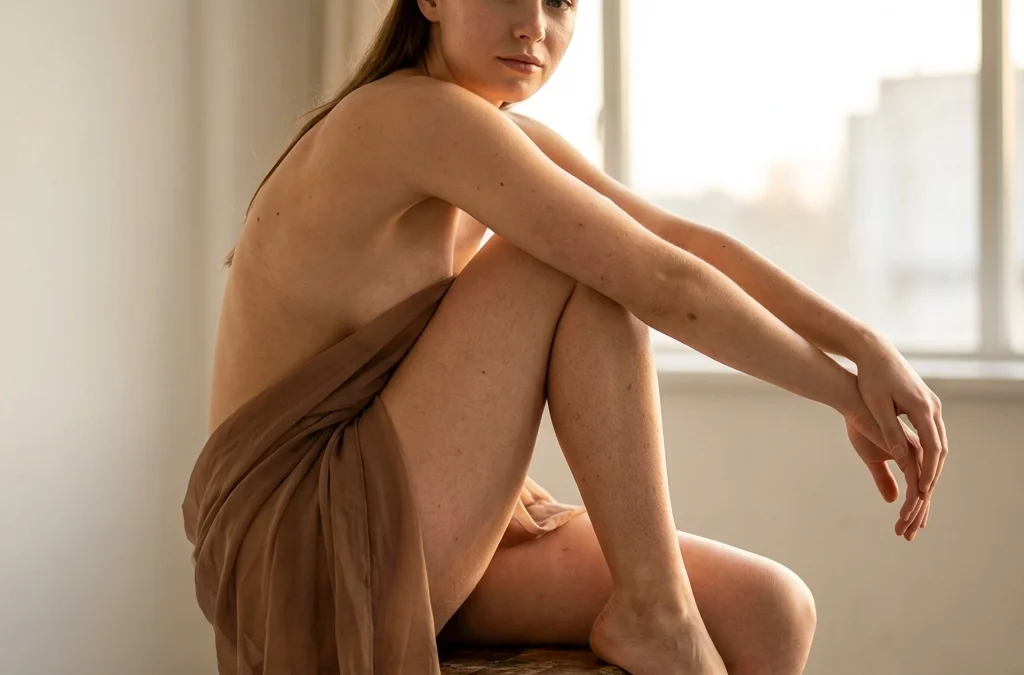
Stepping into the world of fine art nude photography is like learning a new language: one where the alphabet is written in curves, shadows, and the raw, unadulterated beauty of the female form. It’s not just about taking the clothes off; it’s about stripping away the noise to reveal the essence of a woman. Whether you’re looking to capture something soft and ethereal or dark and provocative, mastering the fundamentals of erotic photography is a journey of constant discovery.
If you’re just starting out, the prospect can be intimidating. How do you handle a model? How do you make skin look like marble? How do you ensure the shot feels like high-end art rather than just a snapshot? This guide is designed to break down the barriers, helping you see the body not just as a subject, but as a masterpiece waiting to be framed.
The Vision: Beyond the Naked Body
Before you even pick up your camera, you need a vision. Nude photography is distinct because it relies so heavily on the emotional connection between the viewer and the subject. Are you looking for the geometric perfection of a silhouette? Or are you chasing the intimate, raw texture of skin against silk?
Fine art nude photography is about intent. When you look at a model, you aren't just seeing a person; you’re seeing light hitting a surface. You’re seeing the way a spine creates a leading line or how the curve of a hip creates a perfect arc of shadow. Sometimes, finding that initial spark of creativity can be tough. When I’m looking for a fresh perspective or a specific mood to replicate in the studio, I often explore the hyper-realistic aesthetics of CandyAI to see how digital art interprets form and lighting. It’s a fantastic way to visualize complex poses and lighting setups before you ever step foot in the studio.
Mastering the Light: Your Primary Tool
In erotic nude photography, light is your paintbrush. Without it, the body has no dimension. The goal is to use light to sculpt the model, highlighting her best features while letting others melt into the mystery of the shadows.
The Power of Natural Light
You don’t need a $10,000 flash setup to create world-class art nude photography. Some of the most iconic images ever captured were shot next to a simple window. North-facing windows provide a soft, consistent glow that wraps around the body, minimizing harsh skin textures and creating a timeless, painterly feel. If the light is too direct, a sheer curtain can act as a massive softbox, diffusing the rays into a sultry, even tone.
Studio Lighting and Chiaroscuro
If you want more control, studio lighting for nude photography allows you to play with high-contrast styles like Chiaroscuro. This technique uses a single light source to create dramatic transitions between light and dark. By placing a light to the side or slightly behind your model (rim lighting), you can trace the outline of her body, making her "pop" from a dark background. This creates a sense of depth and voyeuristic intensity that is hallmark to high-end erotic art.
Posing Nude Models: The Art of Direction
One of the biggest hurdles for beginners is knowing how to direct. Posing nude models requires a blend of professional authority and creative collaboration. A model looks to you for guidance; if you’re hesitant, she’ll feel it, and that tension will show in the photos.
Start with the basics. Ask your model to create triangles with her limbs: bending an elbow or a knee creates dynamic shapes that are much more interesting than straight lines. Focus on the "stretch." Asking a model to reach or arch her back elongates the torso and defines the muscular structure of the abdomen and ribs.
Remember, fine art is often found in the details. A close-up of the nape of the neck, the arch of a foot, or the curve of the small of the back can be just as powerful: if not more so: than a full-body shot. If you find yourself struggling with how to transition between looks, diving into our fine art nude tutorials will give you a play-by-play on how to guide a model through a professional set.
Technical Essentials: Lenses and Settings
While your eye is your most important asset, the right gear makes the job easier. For nude photography tips regarding equipment, I always recommend prime lenses. A 50mm or 85mm lens with a wide aperture (f/1.4 or f/1.8) is the gold standard.
Why Wide Aperture?
Shooting at a wide aperture creates a shallow depth of field. This allows you to keep the focus razor-sharp on the model's eyes or a specific curve of her body while blurring the background into a creamy, non-distracting mess. It adds a level of professional polish that kit lenses simply can’t match.
Camera Settings
Keep your ISO as low as possible (ISO 100 or 200) to ensure the skin looks smooth and grain-free. When it comes to shutter speed, ensure it’s fast enough to avoid motion blur: especially if you’re shooting handheld. Even the slightest movement can ruin the sharpness of a beautiful skin texture.

Building Trust and Professionalism
The secret to great erotic nude photography isn't a camera setting: it's trust. You are asking a woman to be her most vulnerable in front of your lens. This requires a high level of respect.
- Communication: Always talk through the shots. Explain what you’re trying to achieve so she feels like a partner in the process.
- Environment: Keep the studio warm. A cold model is a tense model, and goosebumps (unless intentional) can be a pain to edit out.
- Hands-Off Policy: Never touch a model to adjust a pose. Use your words or demonstrate the pose yourself.
When a model feels safe and respected, she will give you more "soul" in her expressions and movements. That raw, authentic energy is what separates a generic "naked" photo from a compelling piece of erotic art.
Composition and the "Golden" Rules
When you're looking through the viewfinder, try to see the body as a landscape. Use the rule of thirds to place a curve off-center, creating a sense of movement. Look for leading lines: the line of a leg leading the eye toward the center of the frame, or a stray lock of hair pointing toward a breast.
Negative space is also your friend. Don’t feel the need to fill the entire frame with the model. Sometimes, leaving a large portion of the image in shadow or empty space makes the subject feel more intimate and isolated, drawing the viewer’s eye exactly where you want it.

Post-Processing: The Finishing Touch
In the digital age, the shoot is only half the battle. Post-processing is where you define your "look." For fine art nude photography, less is often more. Avoid over-smoothing the skin; you want her to look like a human being, not a plastic doll. Enhance the natural highlights and deepen the shadows to add that "pop" and dimension.
Many artists prefer black and white for nude work because it strips away the distraction of skin tone and focuses purely on form and light. It gives the images a timeless, gallery-ready quality. However, if you're shooting erotic nude photography with a modern, high-fashion edge, vibrant skin tones and rich colors can be incredibly provocative.
Join the Inner Circle
Mastering this craft takes time, practice, and a community of like-minded artists who aren't afraid to push boundaries. If you're serious about elevating your work from amateur snapshots to professional-grade art, you need to see how the best in the business operate.
By becoming a member, you get access to exclusive behind-the-scenes content, lighting breakdowns, and galleries that showcase the pinnacle of the female form. Don't just take photos: create icons. Ready to take the next step? Join the club today and start your journey toward mastering the art of the nude.
Fine art nude photography is a celebration of life, beauty, and the courage to be seen. Keep practicing, keep experimenting with light, and most importantly, keep your focus on the incredible women who make this art form possible. Your masterpiece is only one shutter click away.