
There is something inherently raw and electric about capturing the human body. When you strip away the clothes, you aren't just looking at skin; you’re looking at a landscape of curves, shadows, and stories. Fine art nude photography is the ultimate pursuit for any photographer who wants to move beyond the snapshots and into the realm of high-end erotic art. It’s about more than just a naked body: it’s about the interplay of light and form, the tension in a muscle, and the soft glow of a highlight on a hip.
If you’ve ever felt that pull to pick up your camera and explore the world of erotic nude photography, you’re in the right place. But let’s be real: it’s easy to take a "nude photo," but it takes skill, patience, and a hell of an eye to create art. This guide is designed to get you started on that journey, focusing on the two pillars that will make or break your work: light and form.
The Philosophy of the Form
Before you even touch your shutter button, you need to change how you look at your subject. In art nude photography, the body is your canvas. Whether you are working with a woman of deep, ebony skin or someone with a porcelain-pale complexion, every curve has a different way of reflecting light. You aren’t just "photographing a person"; you are capturing a series of shapes.
Beginners often get distracted by the nudity itself. To move into the professional realm, you need to see the body as a collection of geometric lines and organic flows. Look for the "S" curve of the spine, the triangular negative space between an arm and a torso, and the way the light pools in the small of the back. When you start seeing these elements, your nude photography tips become more about architecture than anatomy.
Mastering Lighting for Nude Photography
Light is your paintbrush. Without it, you’re just standing in a dark room with a beautiful woman. When it comes to lighting for nude photography, less is often more. You don’t need a massive studio setup to create something breathtaking. In fact, some of the most iconic erotic photography ever produced was shot with a single light source.
Natural Light: The Soft Touch
Window light is a beginner’s best friend. There is an intimacy to natural light that hard studio strobes can’t always replicate. Position your model so the light hits her at a 45-degree angle (Side lighting). This creates a "Chiaroscuro" effect: a dramatic contrast between light and dark that emphasizes the three-dimensional form of her body. If the light is too harsh, a simple sheer curtain can act as a giant softbox, bathing her in a gentle, erotic glow.
Studio Lighting: Sculpting the Skin
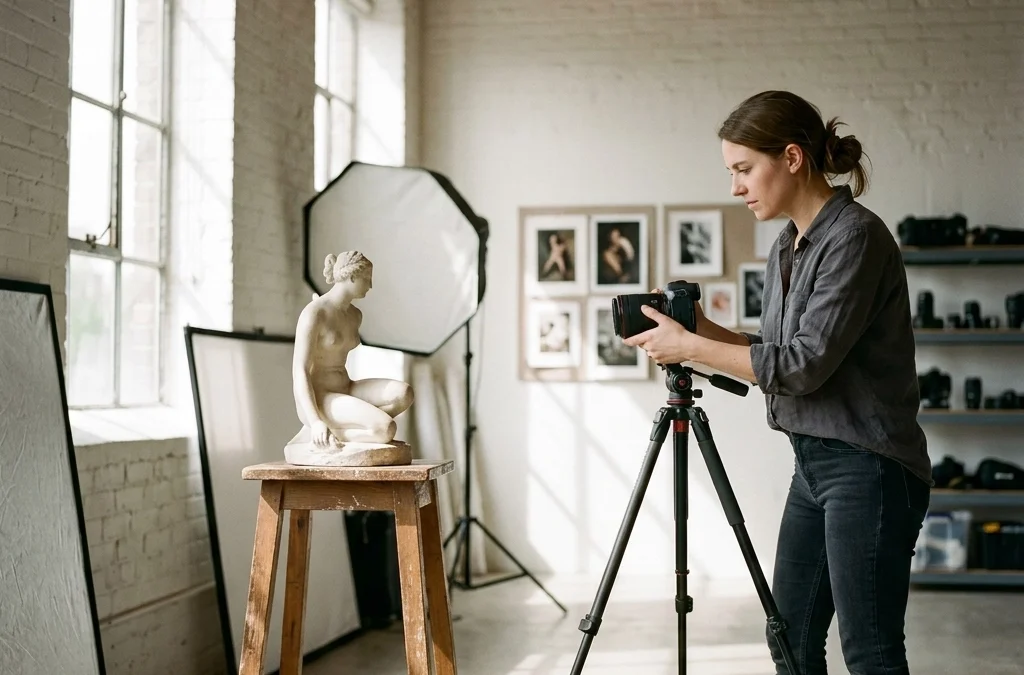
If you want that high-end, polished look, you’ll eventually want to move into studio gear. A single large softbox or an octabank can create beautiful, creamy highlights on the skin. If you’re looking for more drama, try using a "rim light": placing a light behind the model to catch the edge of her silhouette. This is a classic technique in fine art nude photography that separates her from the background and highlights the literal "fine art" of her silhouette.
If you’re struggling to visualize how these light setups will look before your shoot, I often recommend playing around with digital tools to see how different angles affect the female form. You can use something like CandyAI to experiment with different body types and lighting scenarios, giving you a baseline of inspiration before you even step into the studio.
Posing Nude Models: Direction and Flow
Posing is where most beginners freeze up. It’s one thing to have a beautiful model; it’s another to know how to move her. The key to posing nude models is communication and confidence. If you’re nervous, she’ll be nervous.
Start with simple, natural movements. Ask her to breathe, to stretch, or to shift her weight from one leg to the other. High-end boudoir photography poses often rely on tension. A pointed toe, an arched back, or a hand grazing the thigh can add a layer of eroticism that feels sophisticated rather than forced.
Essential Posing Tips:
- The Arch: An arched back creates a beautiful curve in the spine and highlights the glutes and chest.
- The Twist: Having the model turn her shoulders away from her hips creates a dynamic, slimmed-down silhouette and adds interesting folds and shadows to the midsection.
- Hands: Never let hands just "hang." Give them a purpose: touching hair, resting lightly on the hip, or framing the face.
For those who want to get serious about the technicalities of movement, check out our detailed tutorials deep-dive where we break down specific sequences and directives for every body type.
The Equipment: What You Actually Need
You don’t need a $10,000 Hasselblad to get started. In fact, some of the best erotic nude photography is shot on basic DSLRs or mirrorless cameras. The lens, however, is crucial.
A 50mm or 85mm prime lens is the gold standard for how to photograph nude models. These focal lengths are incredibly flattering, as they don’t distort the body like a wide-angle lens would. They also allow for a wide aperture (like f/1.8 or f/2.8), which creates that beautiful "bokeh" or blurred background, keeping all the focus on the model’s skin and form.
Creating a Safe and Sexy Environment
Professionalism is the backbone of the Fine Art Nude Club. When you’re shooting erotic photography, the comfort of your model is your top priority. The room should be warm: remember, she’s naked and will get cold much faster than you. Have a robe ready, keep music playing to break the silence, and always, always ask before you adjust a pose by touching.
The more comfortable she feels, the more she will give to the camera. That raw, authentic connection is what separates a mediocre shot from a masterpiece. You want her eyes to tell a story, even if the photo is just of her back.
Composition: Thinking Outside the Frame
In fine art nude photography, you don’t always have to show everything. Sometimes the most erotic images are the ones that leave something to the imagination. Use "cropping" to your advantage. A tight shot of the curve of a breast, the texture of skin against a silk sheet, or the way hair falls over a shoulder can be more powerful than a full-body nude.
Compositional tools like the Rule of Thirds or Leading Lines still apply here. Use the lines of her body to lead the viewer’s eye through the frame. If she’s lying down, her legs can act as leading lines that point toward the focal point of the image.
Post-Processing: The Final Polish
Once the shoot is over, the work is only half done. Post-processing is where you define the mood. Whether you prefer a gritty, high-contrast black and white look or a soft, warm, and sun-drenched aesthetic, your editing should enhance the form, not distract from it.
Be careful with skin retouching. In the world of high-end erotic art, over-smoothing skin until it looks like plastic is a rookie mistake. You want to keep the texture: the pores, the slight imperfections, the goosebumps. That’s what makes the image feel real and tactile.
Join the Inner Circle
Mastering fine art nude photography is a lifelong journey of learning how to see. It’s about the constant pursuit of that perfect shadow and the perfect curve. If you’re ready to stop guessing and start creating gallery-quality work, you need to be surrounded by the best in the business.
At Fine Art Nude Club, we provide the inspiration, the education, and the community you need to elevate your craft. From behind-the-scenes looks at professional sets to exclusive galleries featuring the world’s most beautiful women, we are the premier destination for erotic art enthusiasts.
Don’t just watch from the sidelines. It’s time to master the art of the human form and take your photography to a level you never thought possible. Click here to join the club and unlock full access to our world. Your journey into the heart of erotic art starts today.