
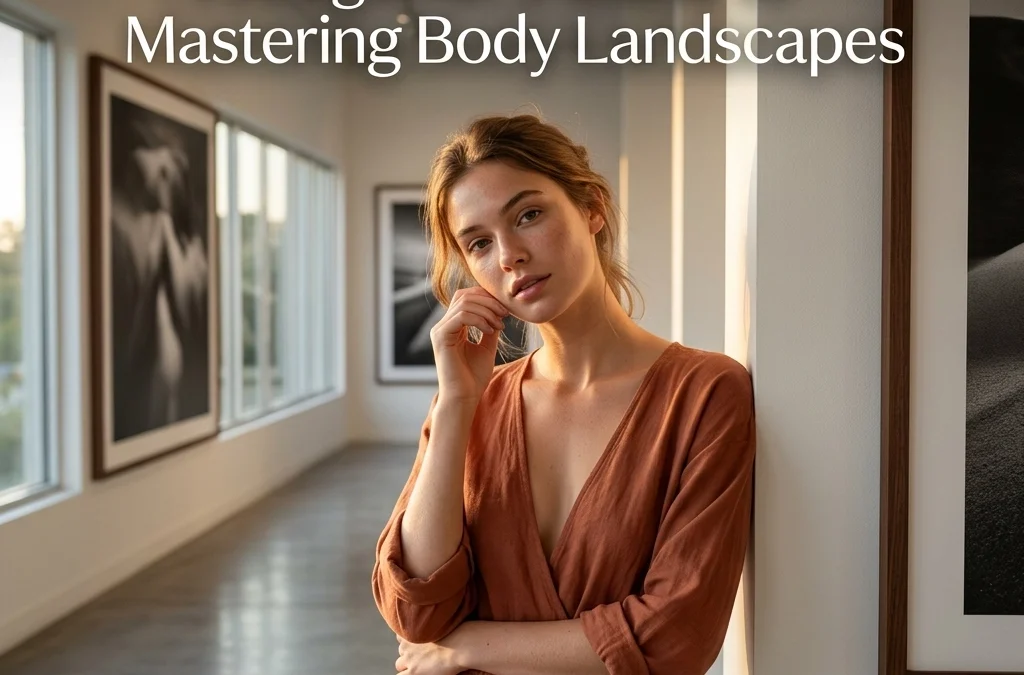
There is something visceral about the human form. It is the oldest subject in art, yet it never gets old. When you strip away the clothes, the labels, and the social pretenses, you’re left with a raw, breathing landscape of curves, shadows, and textures. In the world of fine art nude photography, we don't just see a body; we see a map of experience and beauty. We call this "body landscapes."
For a beginner, the transition from standard portraiture to nude photography can feel daunting. It’s a delicate dance of technical precision and raw vulnerability. But once you master the basics, you realize that photographing a woman’s body is less about "nudity" and more about the interplay of light and skin. It’s about capturing the soul through the architecture of the flesh.
Defining the Body Landscape
A body landscape is an abstract approach to the human form. Instead of capturing a "person in a room," you are capturing the hills of a hip, the valley of a spine, or the soft dunes of a shoulder. It’s about looking so closely at the female form that it becomes something elemental: like a mountain range at dusk or a river carving through stone.
To achieve this, you need to change your perspective. Stop looking at your model as a person and start looking at her as a series of geometric shapes and organic lines. When you narrow your focus, the images become more intimate, more high-end, and significantly more erotic without ever needing to be explicit. It’s the art of the tease, rendered in high-resolution pixels.
The Essential Gear: Choosing Your Weapon
You don’t need a locker full of gear to start, but you do need the right tools. For body landscapes, lens choice is everything. While a wide-angle lens can create interesting distortions, it often ruins the natural proportions of the body if you aren't careful.
A medium telephoto lens, like an 85mm or a 105mm macro, is your best friend. These lenses allow you to compress the image, making the curves look lush and full. They also allow you to stay back a bit, giving your model space to breathe while you zoom in on the details: the goosebumps on her skin, the way a stray hair falls across her lower back, or the subtle shimmer of sweat.
If you want to dive deeper into the technicalities of these setups, our fine art nude tutorial section breaks down the exact settings I use to get that razor-sharp, high-end look that separates the amateurs from the pros.

Lighting: The Brush That Paints the Skin
In art nude photography, light is your brush. You aren't just "lighting a scene"; you are sculpting a body. For body landscapes, the goal is usually to emphasize texture and shape. This is where "low-key" lighting comes into play. By using a single light source: perhaps a large softbox or even just a window with a sheer curtain: you can create deep, dramatic shadows.
Shadows are just as important as light. They are what define the "valleys" of the body landscape. If you light everything evenly, the body looks flat and clinical. But if you let the shadows wrap around the curve of a waist, you create depth. You create a story.
Consider side lighting. By placing your light source at a 90-degree angle to the model, you highlight the silhouette and the skin’s natural texture. It makes the image feel tactile. You want your viewer to feel like they could reach out and touch the skin. To get the lighting right, you have to be patient. Move the light inches at a time until the highlight hits the peak of the curve perfectly.
Posing the Muse: The Architecture of Desire
Posing is where most beginners struggle. A "natural" pose rarely looks good on camera. To create a compelling body landscape, you have to push the body into positions that emphasize its best features. This often means arching the back, pointing the toes, and creating "triangles" with the limbs.
Every bend of an elbow or tilt of a hip changes the landscape. If you're feeling stuck on how to direct your model, you should check out the ultimate guide to posing nude models, which covers everything from standing poses to complex floor work.
Remember, communication is key. You are the director. You need to be able to tell your model exactly how to move to catch the light. "Tilt your chin down," "Arch your lower back just a fraction more," "Relax your fingers." These small adjustments are the difference between a snapshot and a piece of art.

Diversity of Form
The beauty of the "body landscape" philosophy is that it applies to every body. Fine art nude photography isn't reserved for one specific body type. Every woman brings a different topography to the studio.
From the porcelain skin of a redhead to the deep, lustrous tones of a Black model, the way light interacts with different skin tones is a playground for a photographer. Some bodies are all sharp angles and long lines; others are all soft curves and generous volumes. Mastering this art form means learning to appreciate and highlight the unique architecture of every woman who steps in front of your lens.
The Digital Muse: Using AI for Inspiration
Sometimes, the hardest part of a shoot is the pre-visualization. How do you want the light to hit? What kind of mood are you going to create? Before I even pick up the camera, I often use digital tools to brainstorm.
Using an AI companion or generator like CandyAI can be a surprisingly effective way to experiment with concepts, lighting scenarios, and aesthetics without the pressure of a live set. It allows you to visualize the "perfect" curve or the way a specific shadow might fall across a virtual form, giving you a blueprint for when you actually have a living, breathing muse in your studio.

Ethics, Comfort, and the Professional Edge
Let’s get real for a second. Photographing a nude woman requires a level of professionalism that is non-negotiable. Your model’s comfort is the most important factor in the quality of your images. If she is cold, nervous, or uncomfortable, it will show in her muscles. Her shoulders will be tight, her expression will be guarded, and the "landscape" will look rigid.
Keep the studio warm: warmer than you think it needs to be. Have a robe ready for her between setups. Always ask before you adjust a pose physically (though it's better to demonstrate the pose yourself or use verbal cues). When a model feels safe and respected, she opens up, and that’s when you get the raw, high-end erotic shots that feel authentic and powerful.
Post-Processing: Refining the Canvas
The shoot is only half the battle. In the digital darkroom, you refine the landscape. For art nude photography, I tend to lean towards a slightly desaturated or high-contrast black-and-white look. Removing color strips away the "reality" of the image and turns it into a pure study of form and light.
Pay attention to skin retouching. You want the skin to look perfect, but not plastic. Keep the pores. Keep the subtle imperfections that make it human. Your goal is to enhance the natural beauty, not erase it.
Join the Inner Circle
Mastering the human form is a lifelong journey. You can read every guide on the internet, but nothing beats seeing the process in action and learning from those who live and breathe this art form every day.
If you’re serious about moving past the "beginner" label and actually producing gallery-quality work, you need to be part of a community that understands the nuances of the craft. We’ve built a space where you can get exclusive access to behind-the-scenes content, advanced lighting breakdowns, and a network of professionals who aren't afraid to push the boundaries of erotic art.
Don't just take photos; create masterpieces. You can start your journey and get the full experience by choosing a membership that fits your level of ambition. Whether you’re here for the education or the inspiration, there’s a place for you in the club.
The human body is the most complex, beautiful, and challenging subject you will ever face. Treat it with respect, light it with passion, and never stop looking for the landscapes hidden in the curves.