
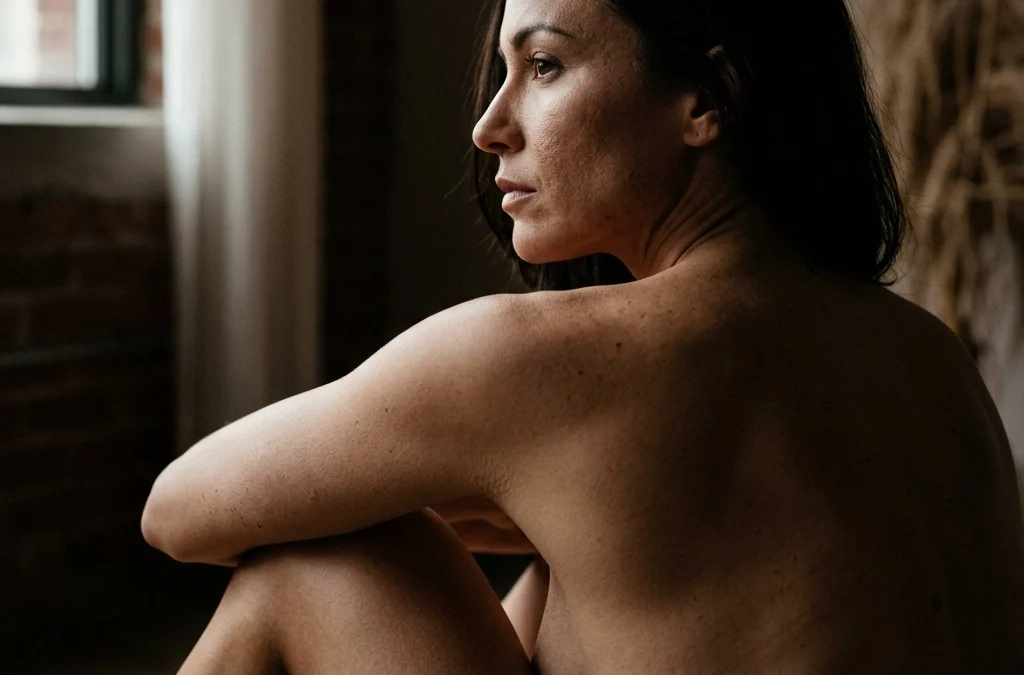
The human body is the most complex, evocative, and timeless canvas a photographer can ever hope to work with. But when you strip away the clothes, you’re standing at a crossroads. One path leads toward the hallowed, quiet halls of a gallery, where the body is treated as a sculptural landscape of shadow and light. The other path leads toward the pulse-pounding, intimate world of desire, where the gaze is direct, the heat is palpable, and the intent is to stir the senses.
This is the age-old debate: Fine art nude photography vs. erotic photography.
For many, the line is a blur: and honestly, that’s where the magic happens. But if you’re looking to master your craft, you need to understand the nuances of both. Whether you are aiming for the high-concept abstraction of art nude photography or the raw, magnetic pull of erotic nude photography, your choice dictates your lighting, your posing, and your relationship with the woman in front of your lens.
The Art Nude: The Body as Architecture
In fine art nude photography, the subject isn't just a woman; she is a collection of lines, textures, and rhythms. The focus here is often on the "how" rather than the "who." We are looking at the way a spine curves like a mountain ridge or how the soft light catches the obsidian glow of her skin, turning a shoulder into a work of marble.
The intent of fine art is often universal. You aren't necessarily telling a story about a specific person’s Tuesday night; you’re telling a story about humanity, vulnerability, and the aesthetic perfection of the female form. When you dive into fine art nude tutorials, you’ll find that the emphasis is almost always on composition and lighting for nude photography that deconstructs the body into shapes.
Think of it as a dance between the light and the dark. You might use heavy chiaroscuro to hide the face and highlight the tension in a calf muscle. The goal isn't necessarily to arouse, but to awe. It’s about the "wow" factor of the visual construction.
The Erotic Edge: The Power of Desire
Erotic photography, on the other hand, is personal. It is intimate. It is unapologetically sexy. While fine art might look at a curve as a geometric shape, erotic photography looks at that same curve and asks, "How does this make the viewer feel?"
Erotic nude photography is about the connection. It’s the gaze that breaks the fourth wall. It’s the slight part of the lips, the arch of the back that suggests movement, and the play of textures: silk against skin, water droplets on a thigh, or the messy tangle of hair. Here, the woman is the protagonist of a very specific, very heated narrative.
If you’re looking for nude photography tips in this realm, focus on the "why." Why are we here? What is the mood? Is it playful? Is it dark and dominant? Is it soft and romantic? The best erotic work doesn’t just show skin; it captures a moment of raw, unshielded energy.
Sometimes, when you’re stuck on a concept or need to visualize a specific mood before a shoot, using tools like CandyAI can help you explore different aesthetics and character archetypes, allowing you to refine your vision before you even pick up the camera.
Lighting for Nude Photography: Softness vs. Drama
Your lighting setup is the quickest way to define your style.
For a fine art approach, you might favor a single, hard light source. This creates deep, ink-black shadows and bright highlights, perfect for "sculpting" the body. You want to emphasize the texture of the skin: the goosebumps, the fine hair, the pores. You’re looking for drama. This style of lighting for nude photography turns the body into a statue, frozen in time and light.
In erotic photography, the lighting often shifts to something more inviting. Think of the "golden hour" glow, or the soft, diffused light coming through a window. It’s meant to flatter and invite the viewer in. Of course, you can go dark and moody here too, but the shadows are usually used to tease rather than to abstract.
Posing Nude Models: Form vs. Feeling
How you direct your model is where the two styles truly diverge.
When you’re posing nude models for fine art, you might ask for poses that are physically demanding or even slightly uncomfortable. You’re looking for tension. You want the muscles to be engaged, the lines to be long and exaggerated. You might have her fold into herself, creating a knot of limbs that challenges the eye to figure out where one ends and the other begins.
When the goal is erotic, the posing becomes more about the invitation. You’re looking for boudoir photography poses that feel natural yet provocative. You want her to move in a way that feels authentic to her sensuality. It’s less about the "shape" of the pose and more about the "vibe." A hand grazing a hip, a slow stretch on a bed, or a direct look over a bare shoulder: these are the elements that build the erotic narrative.
The key to how to photograph nude models in either style is communication. You need to be the director, but she needs to be the co-creator. Whether she’s a porcelain-skinned blonde or a woman with deep, rich ebony tones, her comfort is what allows the beauty to come through.
Which Style Is Right for Your Lens?
Choosing between fine art and erotic photography isn't a permanent decision. In fact, most of the best photographers in the world play in both sandboxes.
Ask yourself:
- Do I want to create something that feels like it belongs in a museum? (Fine Art)
- Do I want to create something that makes the heart beat faster? (Erotic)
- Am I more interested in the body as an object of beauty or the person as a subject of desire?
Often, the most powerful images are the ones that sit right in the middle. They have the technical precision and lighting of fine art, but the soul and heat of eroticism. That’s the sweet spot where "art" meets "raw."
If you’re serious about pushing your boundaries and seeing how the pros handle these delicate balances, you need to be part of a community that understands both. By joining the Fine Art Nude Club, you get a front-row seat to how these styles are executed at the highest level, from the technical lighting setups to the psychological side of posing.
The Technicality of the "Sexy" Shot
Don't let the word "erotic" fool you into thinking it's less technical than "fine art." Capturing a truly high-end erotic image requires a deep understanding of your gear. You need to know how to use a shallow depth of field to draw the eye exactly where you want it: perhaps the curve of her waist is in sharp focus while her face drifts into a soft, dreamy blur.
You need to understand color theory. Warm tones evoke a sense of heat and intimacy, while cooler tones can feel more distant, clinical, or even sophisticated and modern.
And let’s talk about the environment. In fine art, the background is often a void: a simple black or white studio backdrop. In erotic photography, the environment is a character. A rumpled bed, a luxurious velvet sofa, or a sun-drenched balcony all add to the story you’re telling.
Final Thoughts
Whether you’re chasing the abstract beauty of art nude photography or the direct, unyielding power of erotic nude photography, the secret is the same: respect the form. The female body is a masterpiece of nature, and your job as a photographer is to do it justice.
Experiment with both. Try a shoot where you focus entirely on the geometry of the body, then switch gears and try to capture the most intimate, soul-baring look your model can give you. The more you play with the boundaries, the faster you’ll find your own unique voice.
Ready to take your work to the next level? Don't just browse: immerse yourself. Become a member of the Fine Art Nude Club today and start mastering the art of the nude. Your lens is waiting.