
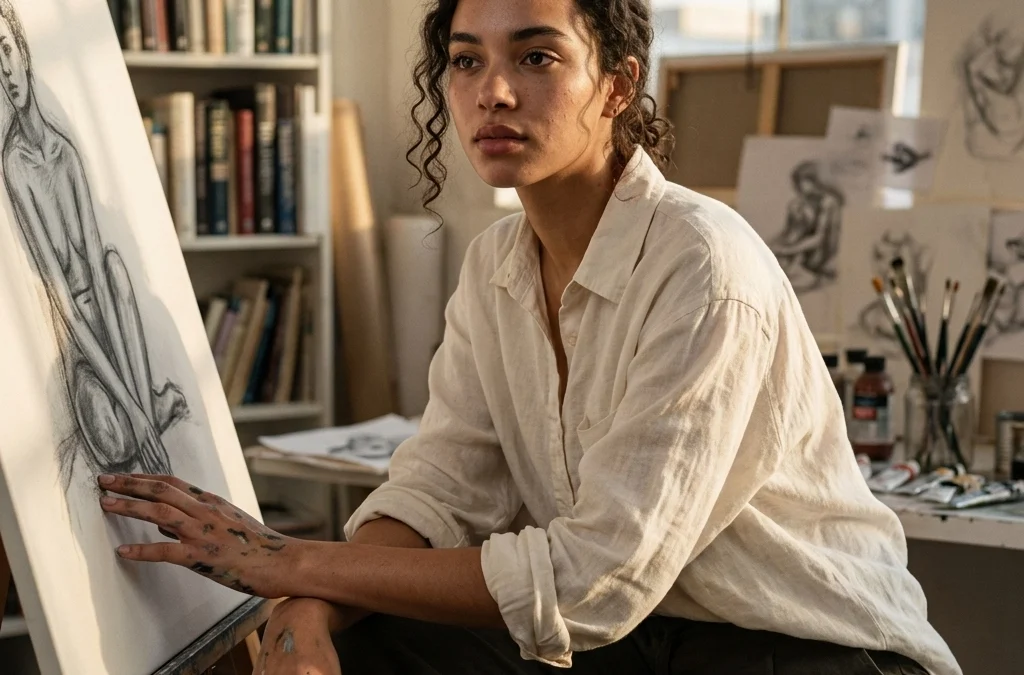
There is a specific kind of tension that exists the moment a model drops her robe in a studio. It’s a silence filled with potential. As a photographer, you’re standing at a crossroads. Do you lean into the shadows, focusing on the abstract geometry of her spine and the architectural grace of her hips? Or do you capture the heat in her eyes, the flush on her chest, and the raw, unadulterated magnetism of her presence?
This is the age-old debate: fine art nude photography versus erotic photography.
For years, critics have tried to build a wall between the two. They claim that "Art" is intellectual and "Erotica" is purely visceral. But if you’ve ever spent time behind the lens, you know that line is as thin as a lace stocking. Both styles celebrate the female form, yet they serve different creative masters. Choosing which path to follow: or how to blend them: is the key to defining your unique photographic voice.
Defining the Fine Art Nude: The Architecture of the Body
When we talk about art nude photography, we are talking about the body as a landscape. In this realm, the model becomes a series of curves, textures, and gradients. The focus isn't necessarily on who she is, but on what her form represents. It’s about the play of light on skin, the way a shoulder blade catches a highlight, or how a deep shadow can turn a waistline into a mysterious cavern.
Fine art nude photography often leans heavily into technical mastery. You aren't just taking a picture; you are composing a symphony of light and dark. This is where your lighting for nude photography becomes your most powerful tool. Using techniques like Chiaroscuro: the dramatic contrast between light and dark: allows you to sculpt the model’s body, highlighting the muscularity and grace of women from all walks of life.
In a fine art context, the "gaze" is often detached. The model might look away, her face obscured by shadow or turned toward a window. This creates a sense of timelessness. You aren't capturing a moment of seduction; you’re capturing a moment of existence. If your creative vision is driven by a desire to create something museum-worthy, something that speaks to the human condition through the medium of flesh, then the fine art path is likely your calling.
The Raw Pulse of Erotic Nude Photography
Now, let’s talk about the heat. Erotic nude photography doesn't apologize for its intent. It is designed to provoke, to excite, and to celebrate the raw, sexual power of the female form. While fine art might treat the body as a statue, erotic photography treats the body as a living, breathing, wanting entity.
This isn't about being "low-brow." High-end erotic photography requires just as much skill as any gallery piece. The difference lies in the connection between the model and the viewer. In erotic work, the gaze is often direct. She looks into the lens, and by extension, she looks at you. There is an intimacy here that fine art often avoids.
When you are learning how to photograph nude models for an erotic set, you are focusing on the details that trigger a response. The curve of a breast, the arch of a back, the way hair falls over a shoulder: these are the elements of a story about desire. If your creative vision is about capturing the electricity of a moment, the erotic path is where you belong.
Why You Don’t Have to Choose
Here is the secret that the "serious" art world won't tell you: the best work often lives in the overlap. Look at the legends like Robert Mapplethorpe. His work was undeniably fine art, yet it was deeply, intensely erotic. He proved that you could use the technical precision of art to elevate erotic themes into something transcendent.
When you're trying to figure out your vision, don't feel boxed in. You can take the lighting for nude photography that you learned in a fine art workshop and apply it to a high-voltage erotic shoot. You can take the boudoir photography poses that emphasize sensuality and shoot them in high-contrast black and white to create a piece of art that feels both classic and provocative.
Sometimes, the best way to find your style is to experiment without the pressure of a live set. If you're struggling to visualize a specific pose or lighting setup, tools like CandyAI can be a fantastic playground for your imagination. You can test out different aesthetics and "models" to see how light interacts with various body types and skin tones, helping you refine your vision before you ever step into the studio.
Posing Nude Models: Finding the Narrative
The way you pose a model is the clearest indicator of your intent. In art nude photography, poses are often inspired by classical sculpture: think of the "Venus de Milo" or the works of Michelangelo. These poses emphasize the flow of the body's lines. You might have your model stretch her arms upward to elongate the torso or twist her torso to create dynamic "S" curves.
In erotic photography, the posing is more grounded in reality and invitation. You might focus on black leggings or lace to add texture and a "tease" element. The poses are often more open, emphasizing the vulnerability and confidence of the model.
Whether you are aiming for art or erotica, the key is communication. A model who feels comfortable and empowered will always give you a better shot. If you’re looking to master these nuances, our deep-dive fine art nude tutorial section covers everything from the psychology of the shoot to the technical settings on your camera.
Lighting: The Great Differentiator
Lighting is the "vibe" of your image. If you want your work to lean toward fine art, think "less is more." A single light source can create incredible drama. By placing a softbox to the side of the model (rim lighting), you can outline her silhouette while leaving the rest to the viewer's imagination. This creates a sense of mystery that is synonymous with fine art.
For erotic photography, you might want more "pop." Using multiple lights to fill in the shadows can highlight the smoothness of the skin and the intensity of the model's expression. High-key lighting: where the image is bright and airy: is often used in boudoir and erotic work to create a clean, modern, and inviting feel.

Which is Better for Your Creative Vision?
So, which is it? Is it the shadow or the skin? The statue or the siren?
The answer depends on what makes you want to pick up your camera in the first place.
- If you are obsessed with the "how": the lighting, the composition, the timelessness: start with fine art.
- If you are obsessed with the "who": the energy, the intimacy, the raw attraction: start with erotic.
Most photographers find that their vision evolves over time. You might start out wanting to shoot pure erotica and find yourself falling in love with the way a specific shadow falls across a model’s ribs. Or you might start as a fine art purist and realize that the most powerful "art" you've ever made was a candid, erotic moment of a woman feeling completely at home in her own skin.
Regardless of where you land, the journey is about exploration. You need a space where you can see how other professionals are navigating these waters. That’s exactly why we built our community. To truly master the craft and see the full spectrum of what is possible when beauty meets the lens, you should join the club and gain full access to our exclusive galleries and expert-led discussions.
Final Thoughts
The human body is the most versatile subject in the world. Whether you call it "fine art" or "erotic," your goal is the same: to capture a truth about beauty. Don't let labels limit your creativity. Use the tools at your disposal, learn the rules of lighting and posing, and then break them to find your own path.
The lens doesn't care about the category: it only cares about the light. Go find yours.